Sunday, April 10, 2011

New Delhi, same-same but different


On 6th March I found myself back in New Delhi - exactly the same but completely different.

The last time I had lived in New Delhi I had shared a flat in Vasant Kunj with other Asha volunteers. This time I moved in with a Punjabi family in Saket, in south Delhi. It is a huge 4-storey place with innumerable rooms. The family consists of a grandmother, father (the mother lives in New York), an adult son and 15-year-old twin daughters, plus three live-in servants. There are seven guest rooms, so the household sometimes consists of as many as 18 people. It is wonderfully busy, with people coming and going all the time. At present, the regular guests consist of myself, a Dutchman named Bart and an American named Katie. Most evenings, some or all of us meet on the rooftop terrace, and there are often up to five local teenagers there too. We all chat about the day and watch the sun set behind the Qutub Minar, the tall tower in the photo. It's a 12th century Moghul monument surrouned by mosques and ruins.


The photo shows one corner of my room - it's so huge that I can't photograph it all at once. The room contains three beds and a private bathroom. Very nice.

We have all our meals with the family. Breakfast is usually eggs and toast while dinner is Indian. There are nearly always three or four kinds of curry or dal with flat bread called roti. It's vegetarian every day except Sunday, when there is some chicken. The food is outstanding and the home is wonderful!

Bangkok


On my way back to India I arranged to meet a friend with whom I'd previously travelled in India and Nepal. Jennie was travelling from India to southeast Asia, so we agreed to meet in Bangkok for three days. I love the way this travel magic works.

We'd both been to Bangkok before so we weren't particularly interested in doing the 'usual' tourist things. We were wandering about when we came across a lake that hired out double-headed duck paddle boats. We couldn't resist this bit of silliness so we hired one and paddled about. We were startled to discover that there was a colony of enormous monitor lizards living in and around the lake. We watched them eat whole fish and birds, lick blood off their faces and generally just look rather threatening. The video shows the slow swagger of these massive creatures.
We then tried to return our double-headed duck boat to the jetty, where the woman in charge helpfully took our picture. But after much babbling in mutually unintelligible languages, wild gesticulating and pointing frantically to the jetty (us) and the other side of the lake (her), we realised that the woman from whom we'd hired the boat had been very pregnant, and this one wasn't. We'd tried to return the boat to another company, in another place. Ah - all double-headed duck boat hire places look alike to me!

Our next stop was the Bangkok Snake Farm, where we saw many snakes (no surprise there) both alive and dead. Not for the faint-hearted.

We visited Jim Thompson House, which is an amazing complex of ancient Thai buildings collected together in one place by an American silk trader in the 1960s. The photos don't do it justice - this is a truly beautiful home. If I am ever a gazillionaire, I'd like to create a home like this. It was perfect: light, space, greenery, ancient sculptures, clean wooden lines, fascinating objects from all over Thailand.

In the evening, we did the obligatory tourist thing of drinking on Khao San Road. Jennie and I were immediately attracted to a bar with a huge sign saying 'we do not check IDs', with every waiter wearing a T-shirt with that message. This was funny because (a) NO bars on Khao San Road check IDs, and (b) Jennie and I are both well above the drinking age. In fact, two-thirds of my daughters are above the drinking age! We were sitting there drinking VERY STRONG cocktails, as the sign informed us, when Jennie was hailed by an Australian man - it turned out that she'd met him in Malaysia a few weeks earlier, and here they both were on Khao San Road in Thailand at the same time. I love the way this travel magic works!

We chatted a bit, well a lot, and something made me think that I ought to know who this chap was - he claimed to have 'worked in Australian politics' but was otherwise vague about his background. A few days later, when I had his full name, I Googled him - well, what else do you do? It turns out he was a disgraced former Queensland politician who had been facing charges there over sexual harassment and workplace harassment. He had lost his seat even though the voters had swung towards his party everywhere else in the state. And the best part? We knew he had been living in Malaysia since September, and were rather tickled to discover a newspaper article asking where he had been since September, when he had apparently 'fled the country'. Part of me felt like contacting Crikey to reveal his whereabouts, but in the end, Jennie and I just decided to have another cocktail ......


So what else do you do in Bangkok after you've paddled in a double-headed duck boat, visited a snake farm and caught up with an Australian former politician on the run? Of course, you go to the zoo to see a Kenyan Boys Acrobatic Team. And that we did.

The Kenyan Boys were entertaining, to say the least: semi-naked, covered in oil and pelvic thrusting the whole way through the show. Some day I'll show you the videos, but this is a family blog, so let me just leave you with a photo of me with one of the Boys. Look at that six-pack.


The rest of the zoo was almost as entertaining. Jennie somehow managed to get shat upon by a penguin with a bad case of diarrhoea, through a gap in a glass enclosure. The photo shows the aggrieved Jennie, the offending penguin and the dirty window!


Finally, we were rather confused about all the pictures of pandas, panda signs and jolly little panda souvenirs that were on sale. There are NO pandas at Bangkok Zoo folks, don't be fooled. Well, except for the ATM, which was shaped like a panda. Since this was the closest I was going to get to a panda in Bangkok, I took a photo of the ATM. And here it is.

Canberra


On 2nd February I returned to Canberra for a month, to count my children, sort out my finances, write some papers and try to work out what I was going to do with the rest of the year, or indeed the rest of my life. I stayed with the extremely lovely Philip and Iris, and their gorgeous son Jeffery, aged 10 months. My room faced the road where extraordinarily loud roadworks began every morning at 7am. I am convinced that Philip and Iris put me in that room to ensure that I did not overstay my welcome. The photo shows me with baby Jeffery standing near one of the wretched machines that disturbed my slumber. Jeffery is extremely cute and my plan had been to smuggle him with me in my cabin baggage when I left, but sadly I discovered that he weighed 7.2kg, which is over the limit, so I had to leave him behind. I spent many happy evenings with Philip arguing about whether or not all Christians had to be pacifists all the time (him - yes, me - no) and whether eating camembert at room temperature made me more bourgeois than him.


I spent time with my wonderful daughters Lyndal, Michaela and Elwyn and was delighted to have the opportunity of watching the latter two play baseball. Their team is coached by a former professional baseball player who has played in the US, and they thrashed their opponents comprehensively. Whether it was the outstanding coaching, or the running skills developed by the team during the soccer season, we will never know. The photo (right) shows Elwyn and Michaela enjoying sisterly love. Well, maybe Michaela is enjoying it! The photo below shows Elwyn having more fun.


Since my academic career, if I ever have one, will depend on publications, I spent many hours writing papers for peer-reviewed journal articles. To date, only one has actually been published but the others are due out this year. Hopefully, in the academic world there will be many references to Day (2011) in years to come. Sigh.

I spent an enjoyable weekend in Melbourne with my extended family, including numerous cousins of varying degrees. It was also very special to meet Bailey again. Bailey is a labrador who had been our family pet for the first five years of her life, when we gave her to my cousin Rachel, who offered a home with many children and loads more attention than she received at our place. Bailey, who was named after an ancestor that went down on the Titanic, had a much happier life journey than her namesake and looked fat and contented, as labradors should be.

Then there was a franctic round of paperwork to deal with. I applied for, and received, my new tourist visa for India and also applied for a Person of Indian Origin (PIO) card. If I'm succesful, I will be entitled to bypass all the visa requirements for India in the future. I also examined my PhD carefully and discovered that it was wrong - my discipline was Biological Anthropology, not AnthropologyAnthropology [sic]. I began the tedious process of getting that fixed.

I had many meals with my daughters, drinks with friends, meetings with bank managers and chats with bureaucrats of every kind. I officiated at Elwyn's school swimming carnival, helped move Michaela into her father's garage, dumped my excess possessions into storage and bought new underwear to replace all that had been destroyed by being smashed against rocks in laundries throughout Asia. Then it was time to leave. I promised to write more often and update my blog regularly. OK, the latter turned out to be a lie.

On 3rd March, I headed to Bangkok, en routte to India, for Round 2.

Diving in Timor


OK, it's been brought to my attention several times that I have not updated my blog for two months. So here goes. I will attempt to bring it up to date.


In January 2011 I completed my Advanced Open Water Diving Course in Dili, East Timor through Dive Timor Lorosae. I can't speak too highly of the staff at Dive Timor, or the quality of the diving. They were both awesome! Each night, after diving or working, there was always a crowd of people to socialise with at the Castaway Bar, which is connected with Dive Timor. There was great food, good wine and terrific company.


After I completed the course I went on to do a number of other dives, just for fun. I saw giant clams, beautiful sea slugs, the occasional ray, gorgeous coral and amazing coloured fish. Yet I was told that the visibility was comparatively poor and that it was much better later in the year. I will have to go back!


I don't have an underwater camera, so to give you a taste of what I saw, I have shamelessly downloaded these photos from the Dive Timor Lorosae website, which has copyright.

Friday, February 11, 2011

Liquisa and Maubara


In between volunteering at Alola and going scuba-diving with Dive Timor Lorosae, I managed to spend a day 'sighseeing' west of Dili. My friend Hannah and I managed to gently persuade two Portuguese naval officers to take us along with them on their daily trip to Liquisa, where they worked.

Paolo and Augusto are working to reconstruct the hospital at Liquisa, which is about an hour's drive west of Dili. The photo above shows a view from the back of the main hospital building, where the shell of a destroyed building can be seen. On the other hand, the main building has suffered not from violence but from neglect. The photo on the left shows the front of the restored main building of the hospital, with Augusto on the doorstep. The inside has been completely re-tiled, re-wired, re-plastered and re-painted. Paolo and Augusto hope that it will be finished soon, but on the day we arrived, as on other days, all the workers had simply failed to turn up for work. Someone was getting married apparently, or someone had a problem with transport, and they just all took the day off. This was unfortunate for the reconstruction of the Liquisa hospital, but fortunate for Hannah and I, since we now had two ready-made tour guides, with no work to do.

First we headed for the beach. Liquisa formerly had a beach resort, but like so many of Timor Leste's economic activities, this was destroyed during the independence struggle. The beach was clean and pleasant, although Hannah was put off by the black sand. We were assured that this was from the nature of the volcanic soils, not from anything sinister or dirty. It's curious how we associate the colour of the sand with the quality of the beach - in Dili the sand is white, but the water is filthy since raw sewerage pours into it and container ships offload their waste into it. In Liquisa it's black, but clean, yet somehow is less appealing.

We explored Liquisa a bit. This was the scene of much bloodshed during 1999 and the town was used as a set in the film Balibo in 2008. We visited the now-destroyed Indonesian army officers' mess, which has a shallow lake behind it (shown left). This was a place where allegedly the Indonesians threw Timorese, bound hand and foot, to be eaten by crocodiles. I can't say whether that's true or not, but it is certainly a fairly spooky place.

We then moved on to Maubara, several kilometres further west. Maubara was infamous for being the place where the Besi Merah Putih militia group was formed. This group of Indonesian-backed Timorese was implicated in much of the death and destruction that occurred in 1999. Maubara had once been a Dutch colony, and they built a fort here, before swapping it with the Portuguese for Flores Island in the 17th century. The fort, and its cannon, still exist. The photo on the right shows one of the cannon pointing out to sea, past the small souvenir stands on the beach.

After snorkelling on a coral reef, then having lunch in the gardens, we were about to explore the fort when the Portuguese Defence Attache showed up at one of the souvenir stands. Since Paolo and Augusto were supposed to be working in Liquisa (despite the fact that no Timorese workmen had shown up that day), our Portuguese friends thought that discretion was the better part of valour, so we high-tailed it out of Maubara and up to the old Portuguese military headquarters on the hill. It felt a bit like wagging school (playing truant) and spotting a teacher in the street, then running away to avoid detection.

The photo has a bit of symbolism for me. The military headquarters, which had once been magnificent, had been restored in 2000, then fallen into disrepair. Now someone has a plan to make it into a hotel, but progress is slow. The photo shows a once-glorious building, now falling apart, with Timorese workmen sitting on the verandah waiting for instructions, or supplies, or plans, or more workmen, or something or other else, to get them going. There was nothing happening. The photo was taken by an expat (me) in the company of other expats (Paolo and Augusto) and we were each struggling with the complexities of assisting the Timorese to re-build Timor-Leste. It's a long, hard struggle and full of disappointments, but in the end, it's got to be worth it.

Friday, January 28, 2011

In the Mountains of Timor-Leste


The drive to Macu's home village had two phases: first we drove along the coast to Baucau, then we headed inland and up into the mountains. Timor is not well-mapped but you can gain a sense of our location on this Google map. The road up the mountains reminded me a bit of the drive from the Indian border to Kathmandu. The big difference is that in Nepal the roads were reasonably well maintained (ie. they didn't have pot holes a metre deep as in Timor-Leste) and the plunge to certain death was only about 500m straight down, rather than 1500m as in Timor-Leste. This is not a road for the faint-hearted.

In all, it took us about 8 hours to travel from Dili to Osso Huna in the sub-district of Baguia. Macu's village is situated on the slopes of Mt Matebian, which is the second-highest mountain in Timor. During the resistance against Indonesian occupation, this area was a key stronghold of Falentil (the armed wing of Fretilin) as the treacherous terrain made pursuit of the guerrillas difficult. The Timorese government has just completed a road through Osso Huna, which spared us a two-hour walk from Baguia town. Progress is coming to Baguia.

Macu’s family’s house was typical of the village. It had dirt floors, walls of bamboo and a roof made of palm fronds. There was no electricity, running water or mobile phone reception. The photo on the right shows the kitchen - two fires surrounded by stones holding up the pots. The puppies sleep next to the fire most of the time as it can be quite cool in the mountains.

The bathroom (left) consists of three corrugated iron walls (no roof), a curtain for the fourth wall, a slatted bamboo floor and a drum with water coming via gravity directly from a nearby stream. Thirty years ago in Malaysia, my stepmother Crina taught me how to wash in this way without ruining the water for everyone else. A very useful lesson.

Dinner that night was to be a goat which had been purchased especially for the occasion. As the honoured guest I was asked how I wanted it killed. This is not a question I'd thought about much before. I asked what the options were and was told that they could hang it by its neck until it was dead, or cut its throat. I guess that letting it die naturally in its sleep was not a third option. So I chose throat-cutting as I thought that it would be quicker and cleaner. I photographed the whole business from patting the goat to serving it in bowls, but for this blog I will just post the first picture, the goat being patted. After being killed the goat was placed whole on a roaring fire of palm leaves, while the hair was scraped off the skin. When it was smooth, it was butchered in a neat and careful manner. Every part of the goat was consumed although I confess that I turned down the offer of the goat's windpipe, claiming that I was full. As generous hosts, Macu's family were concerned that I had not eaten enough and they cheerfully offered to kill one of the puppies for me to eat later in the evening. I declined the offer, but I guess we know the eventual fate of those little puppies sleeping by the fire. One day they’ll be closer to the fire than they are now.


The people were incredibly friendly and keen to show me their lives. Everywhere I went I was followed by a small crowd of children, who periodically shouted out 'melai' and giggled with delight when I smiled back at them. 'Melai' means 'foreigner', but is a descriptive term rather than an insulting one. Most Timorese refer to each by their relative positions (eg. sister, auntie) rather than use their names, and 'melai' is an extension of that. My 'position' in the village was that of foreigner.
One day Macu and I walked to the next village to visit her grandmother. The photo on the left is part of the crowd of children who followed us the whole way, out of sheer curiosity to see what the funny foreigner would do next. Sometimes I made funny faces, which they thought was hysterical and they shrieked with laughter. They don't get many melais in this part of the mountains and certainly not ones that can make fish faces.

We visited Macu's grandmother and her traditional house is shown at right. I conversed through Macu, since my combination of English and Bahasa Indonesia (the two 'working languages' of Timor-Leste) was useless in an area so remote that no-one even spoke the 'national' language of Tetum, let alone foreign languages. Macu’s grandmother was a gracious old lady who was curious about why a foreigner would bother to come to such a place as her village. It was hard to communicate how delighted I was just to meet them and share their meals. I don't think she was much wiser about my visit when I left. And I think she was downright confused when I showed the local children how to hypnotise a chicken. OK I’ll admit that imparting that particular skill is not high on the priority list of international aid agencies, but surely all knowledge is useful, right?

We visited Macu's aunt, whose house had been destroyed by fire a few weeks earlier. She literally owned nothing but the clothes she stood up in. She was very apologetic that she couldn't offer us anything to drink, but she had no possessions of any kind. I asked Macu if it was appropriate for me to give her aunt some money to help out - since no-one else in the village seemed to have money (it's basically a subsistence economy) and no-one else had 'spare' clothes to give her. Her family were happy to feed her and provide her with shelter, but they were all so poor that they could not help in any material way. Macu said that it was OK to give her money and say that it was 'to buy a sarong'. So I gave her $20, which is about two months income in that area. She protested but Macu told her it was OK to take money from me since I was very rich! So we all finished with our dignity intact.

We also visited the local junior high school (pictured right). The salaries of two of the teachers are paid by the Friends of Baguia, a Melbourne-based community organisation that raises funds for this area. The Timorese government cannot afford to pay all the teachers required. In some villages the teachers have to work for free, while they negotiate with the government. In Baguia they are fortunate in having some outside support.


One day an uncle of Macu’s built a new house. The whole village and several nearby ones were invited to participate. It took perhaps 100 people one whole day to build the new house. One photo shows some of the men stripping the leaves from huge palm fronds to make the roof. Other men had gathered the palm fronds and still others tied the leaves into bundles.
Another photo shows the men putting the roof on the house. The photo (below) shows some of the dozens of women who were constantly cooking and feeding the men. Everyone had a job to do.

On my last night in the village, a huge swarm of fireflies came to the jungle behind the house. It was pitch-black and the thousands of little flashing lights darting about the jungle was an awesome sight. Then a thunderstorm started to form behind us, so the fireflies' dance was punctuated with great flashes of lightning. The whole jungle was illuminated for half a second, all the trees were suddenly visible and the fireflies invisible. Then the darkness came back - the jungle disappeared and the fireflies were there again, flashing and darting about. It was an amazing sight.

Finally, it was time for us to return to Dili, after a fascinating few days in the mountains, experiencing a very different lifestyle to that of Canberra. We are told that within six months, Osso Huna will have electricity, and indeed the power poles have already been put up. I wonder how life will change for Macu’s family when they have access to electricity and possibly television? Whatever happens, it won’t be the same.


Wednesday, January 19, 2011

First Week in Dili


I've been in Dili just over a week now, and it's been quite an experience. It is in some ways a typically poor Southeast Asian town, with shabby little huts, open drains, burning piles of rubbish and stray dogs wandering about. What is unique about Dili is the overwhelming presence of the UN. The place is swarming with expats, and I estimate that about half of the expats I've spoken with are from the UN. The rest fall into the same category as me, which is volunteer for an NGO. I counted cars one afternoon out of curiosity - 1 in 10 vehicles that drove by were white UN vehicles. Many of the other vehicles were little yellow taxis, government vehicles and vehicles belonging to international aid agencies. Very different from other places I've been recently.

The UN are visible in the streets, particularly the UN police, of which there seem to be hundreds. The Timorese police and their military are also present in large numbers. The presence of all these uniformed men and women, coupled with the burnt-out buildings, is a constant reminder that there has only been peace in Dili for a relatively short time. Friends give me dire warnings about not venturing out after dark, and for now, I will take them at their word.


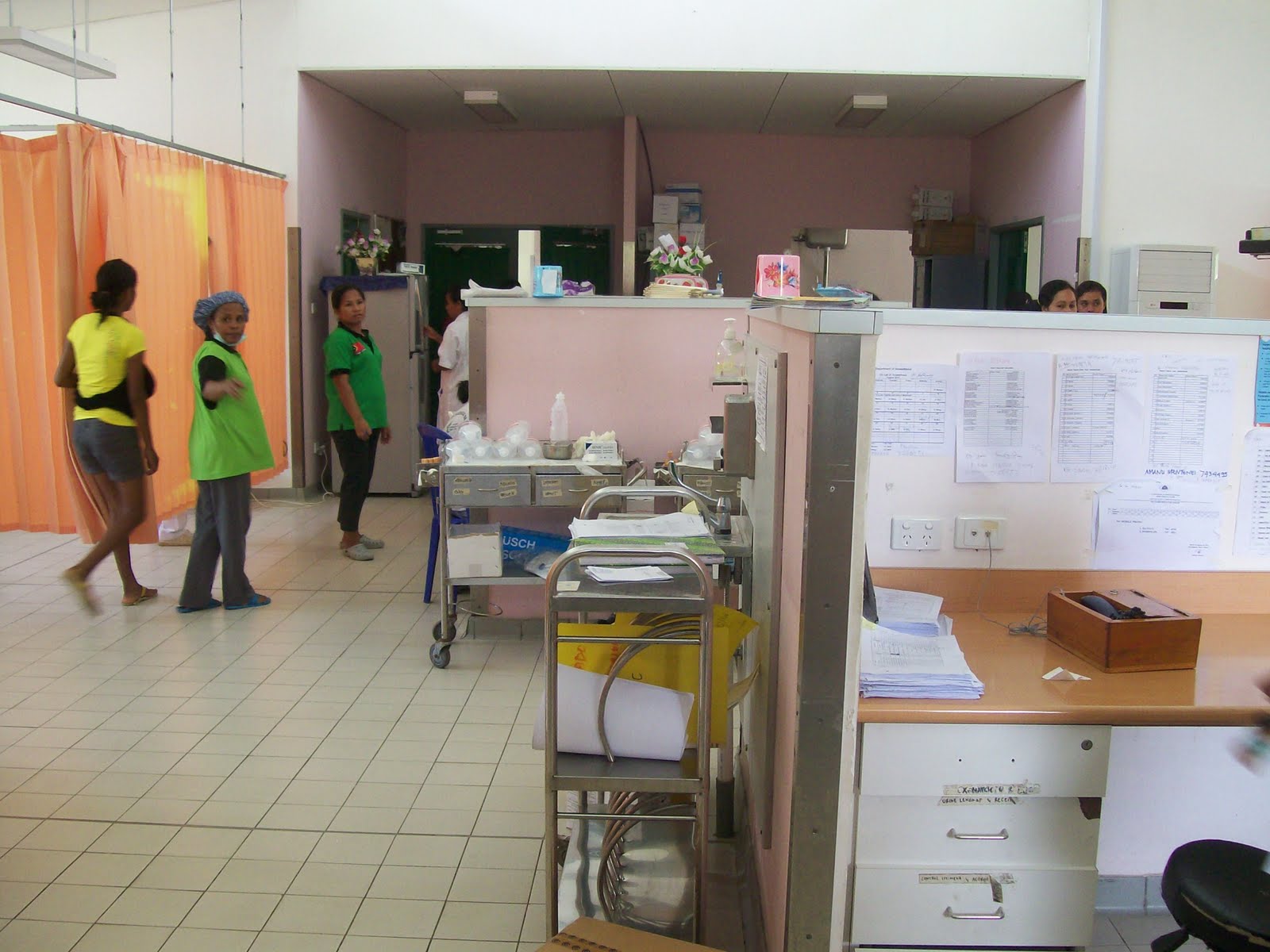
I'm volunteering with a local NGO called Alola Foundation, which focuses on improving women's and children's health, education and economics. East Timor has the 2nd highest maternal mortality rate in Asia, after Afghanistan, and my job is to write and edit proposals to seek grants from donor agencies for projects to address maternal and infant mortality. I've visited the Dili National Hospital and the Bairo Pite Clinic. These are the two places where women can give birth with the aid of trained personnel. The maternity ward of the Dili National Hospital, shown below, is clean and well-maintained, and the staff are committed and well-trained.
The problem is that there are so few beds and the staff are so over-worked. There are only two obstetricians in the entire country. Sometimes the maternity ward is so full that the staff lay mattresses on the floor of the ward, or in the corridor, and women give birth there. Women and their babies are usually sent home in less than 24 hours, to make room for the next ones. There are so few places like Dili National Hospital that only about 20% of women can deliver their babies in any kind of health facility. This is a major contributor to the very high death rate for mothers and their babies.

In my time off from work, I mostly go scuba-diving, or sit in the bar of the pub with other scuba-divers talking about scuba-diving. East Timor has some brilliant dive sites. The coral at Christo Rei (one end of Dili harbour with a giant statue of Christ on it) is the best I've seen. Since it's wet season, the visibility is not great (3-6m or so) but what we can see close up is outstanding. I wish I had Lyndal's underwater camera to show the sites and sights. You might like to visit this website and look at their photos.

Other than working, diving, chatting in bars and swimming, there are the usual bizarre expat activities of quiz nights, karaoke and cards (not at the same time). These are not things I would usually do at home, but then I don't scuba dive much in Canberra either. :-)

Today I am heading off to the mountains to visit the home village of my friend Macu. There is no electricity, mobile coverage or internet, and not really much of a road either. It will take us 8 hours to get there. This will be interesting!